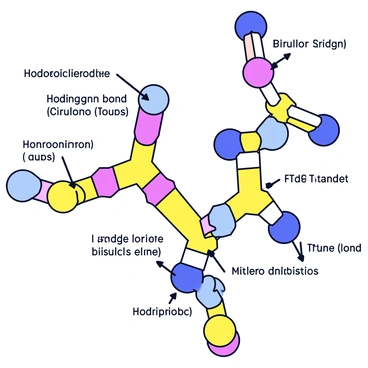
Shows interactions that form tertiary protein segment

Spheres representing different types of atoms, such as carbon, nitrogen, oxygen, and sulfur, arranged to form a complex and intricate protein's tertiary structure. The spheres vary in size and color to indicate the types of atoms they represent. The overall arrangement showcases the three-dimensional folding of the protein with clearly defined curves and angles, emphasizing the unique shape and structure essential for its biological function.A landscape-like view of a protein's tertiary structure is displayed. The structure features various folds that create distinct hills and valleys. The hills rise sharply, showcasing the intricate angles and contours of the protein. The valleys dip lower, revealing deeper crevices and folds that add texture to the overall form. There are intricate details along the surface, resembling a natural terrain with varying elevations and patterns. The view emphasizes the three-dimensional aspects of the structure, highlighting the complexity of its shape.A visual representation of a "path of interactions" is illustrated with various molecules engaged in a series of dynamic connections. At the forefront, a chain of amino acids is shown, each represented by colored spheres, connected by lines indicating peptide bonds. Surrounding this chain, small clusters of differently shaped molecules symbolize enzymes and chaperones, actively interacting with the amino acid chain. In the background, distorted patterns of "folds" and "loops" emerge, depicting the developing structure of the protein as it undergoes various interactions. Each interaction point is highlighted with glowing dots, representing energy transfer during the process. The overall scene is filled with vibrant colors, showcasing the complexity of molecular interactions.A detailed illustration of a complex protein structure is placed in the center of the image. The protein is shown as a series of interconnected layers, each representing different aspects of molecular interaction. Colorful strands of amino acids twist and turn, forming intricate shapes and patterns. The layers are distinguished by varying degrees of transparency, allowing glimpses of the underlying structures. Small, spherical molecules are depicted interacting with the protein, highlighting points of attachment and functional sites. The background is subtly textured to enhance the focus on the protein structure, emphasizing its complexity and beauty.A ribbon diagram illustrating the tertiary structure of a protein in bright colors. The protein's helices and sheets are clearly visible, with distinct turns and loops connecting them. The diagram should include labels indicating different regions of the protein, using clear and legible font. The background should be a solid color to enhance visibility of the protein structure.A 3D icon of a lock and key model representing protein folding. The lock is richly detailed, with grooves and contours that demonstrate how it precisely fits the key. The key features intricate notches and shapes that articulate its unique structure. Surrounding the lock and key, there's a representation of amino acids connecting and folding in a dynamic manner, symbolizing the process of protein folding. The entire composition emphasizes the interaction between the lock and key, illustrating how they come together in perfect alignment.A protein structure is depicted, showcasing its hydrophilic surface interacting with an aqueous environment. The protein has a complex three-dimensional shape, with various amino acid side chains prominently displayed on the surface. These side chains are oriented outward, highlighting their polar characteristics. Surrounding the protein, water molecules are illustrated in a fluid manner, emphasizing the interaction between the hydrophilic areas of the protein and the surrounding aqueous medium. The overall composition conveys a sense of molecular activity and interaction.A lattice-like structure composed of interconnected protein molecules. The protein molecules are arranged in a repeating pattern, creating a three-dimensional framework. Each protein unit has distinct shapes and orientations, contributing to the overall lattice formation. The structure features small spaces between the protein connections, allowing for a sense of depth and complexity. The colors of the protein units vary, creating a visually striking contrast throughout the lattice.A collection of molecules is visually represented as they come together to embrace and form a stable protein structure. The molecules have distinct shapes and sizes, showcasing their complexity and diversity. They are tightly interlocked in various orientations, highlighting the intricate bonds between them. The entire assembly is depicted with precise lines and curves, capturing the elegance of molecular interactions. The protein structure is presented in a way that emphasizes its stability, with a clear depiction of the spatial arrangement of the molecules.A molecular bridge connecting two parts of a protein's tertiary structure. The bridge is depicted as a series of atoms linked together, with distinct colors representing different elements. The protein itself has a complex, folded appearance with various secondary structural elements visible. The overall composition shows a dynamic interaction, emphasizing the importance of these bridges in stabilizing the protein's shape.A modern pastel illustration of a jigsaw puzzle laid out on a light-colored surface. The puzzle pieces are shaped like various protein structures and are diverse in color, including shades of blue, green, and pink. Some pieces are connected, while others are scattered around, symbolizing the intricate interactions within a protein. In the background, there are subtle representations of molecular structures, enhancing the theme of complexity and interaction. The puzzle's edges are slightly curled, and a few pieces are raised above the surface, creating a sense of depth.A group of molecules is depicted in a dynamic arrangement, showcasing their movement as if engaged in a dance. Each molecule displays distinct shapes and sizes, with some curling and twisting to represent various stages of protein folding. An array of colorful trails flows from some of the molecules, visually emphasizing their motion and energy. The background features abstract representations of a cellular environment, adding context to the scene, while ensuring each molecule stands out in the composition. The overall visual conveys the complexity and elegance of molecular interactions.A detailed illustration of a protein structure in a three-dimensional arrangement. The protein is composed of various amino acids forming a complex chain, with distinct sections showcasing alpha helices and beta sheets. Around the protein, there are numerous dashed lines symbolizing van der Waals forces, indicating the interactions between different parts of the protein. The background shows a simplified depiction of surrounding water molecules, emphasizing the biological context. The protein structure itself is prominently displayed at the center of the image with a focus on its intricate folds and loops.An illustration of a protein structure is displayed prominently. In the center, an alpha helix is depicted, characterized by its spiral shape and regularly spaced turns. It is shown twisting and bending gracefully. Adjacent to the alpha helix, a beta sheet is presented, with strands arranged parallel to each other, forming a flat structure. The alpha helix and beta sheet are shown interacting at specific points, with connections illustrated where they come into close contact. The background is simple, allowing the protein structure to be the focal point of the image.A modern pastel illustration featuring a three-dimensional representation of a protein's tertiary structure. The protein is depicted in vibrant shades of blue, green, and purple, showcasing its complex folds and interactions. Surrounding the protein structure are various molecular components, such as small spheres representing atoms, and delicate lines illustrating bonds between them. The background is a soft gradient, enhancing the focus on the protein while maintaining a clean and modern aesthetic.A cosmic scene depicting proteins interacting in a universe filled with molecular activity. Various proteins are illustrated as intricate, three-dimensional structures floating in space. They are linked by strands resembling molecular chains, creating a dynamic network. Small molecules represented as circles and other shapes orbit around the proteins, suggesting active interactions. The background consists of abstract representations of other molecular forms, enhancing the sense of depth and complexity in this molecular universe.A three-dimensional representation of a protein molecule is displayed prominently. The protein is shown with a central hydrophobic core surrounded by various amino acid side chains. The hydrophobic regions are represented in shades of blue and green, indicating stability. The tertiary structure of the protein is well-defined, showcasing its complex folds and twists. Light reflects off the smooth surfaces, emphasizing the intricate details of the protein's formation. Surrounding the protein, there are faint lines illustrating interactions with water molecules, showing the contrast between the hydrophobic core and the aqueous environment. The entire image is bathed in a soft gradient that enhances the visual appeal of the molecular structure.A roadmap depicting the folding process of a protein into its tertiary structure. The roadmap is divided into several sections, each illustrating a stage of the folding process. The starting point features a linear chain of amino acids. In the first section, the chain begins to fold into local structures such as alpha helices and beta sheets, represented by curved and zigzag lines. As the viewer moves along the roadmap, the next section shows these secondary structures coming together, with interactions depicted by small symbols indicating hydrogen bonds. The final section culminates in the fully folded tertiary structure, showing a complex three-dimensional shape with intertwined regions. Each section is clearly labeled with arrows indicating the direction of the folding process.A diagram showing "ionic bonds" forming between different parts of a "protein segment." The protein segment is depicted as a chain of interconnected "amino acids." Each amino acid is represented with distinct shapes and colors, while the ionic bonds are illustrated as "lines" connecting the positively and negatively charged regions of the amino acids. The background is plain to emphasize the protein structure and the ionic interactions.A close-up view of hydrogen bonds connecting the different parts of a protein's tertiary structure. The protein is depicted with intricate folds and bends, showcasing its complex three-dimensional configuration. The hydrogen bonds are represented as dashed lines between nitrogen and oxygen atoms, emphasizing their role in maintaining the protein's stability. The surrounding molecular environment includes nearby atoms and side chains, highlighting the protein's interactions with its environment. The overall composition captures the detailed architecture of the protein at the molecular level.A detailed 3D model of a protein is displayed prominently in the center of the image. The protein's tertiary structure is complex, featuring multiple intertwined polypeptide chains that create a unique three-dimensional shape. Each chain is represented in a different color, showcasing the diverse amino acids that make up the protein. The surface of the protein has a glossy texture, reflecting light and enhancing the visualization of its intricate folds and grooves. Annotated labels indicate specific regions of interest, with arrows pointing to active sites and binding pockets on the protein's surface. The background is a soft gradient that transitions from light blue at the top to white at the bottom, emphasizing the protein model.A group of chaperone proteins in their complex, three-dimensional form, actively interacting with a nascent protein chain. The chaperone proteins are shown as distinct, elongated shapes with various connectors and domains. The nascent protein chain appears as a tangled wire, while the chaperones are stabilizing it into a well-defined, stable structure. The scene emphasizes the dynamic process of protein folding, highlighting the commitment of the chaperones to ensure proper conformation.An illustration showing several disulfide bridges linking different sections of a protein structure. The protein is represented as a series of colorful, intertwined chains that twist and loop around each other. The disulfide bridges are depicted as bright yellow connections between specific points on these chains. The background is left simple to emphasize the complexity of the protein's structure and the importance of the disulfide bonds.A close-up view of a protein structure highlighting the interaction between various side chains. The protein is represented in three-dimensional form, with distinct colors assigned to each side chain for clarity. The side chains are shown as colorful protruding groups, with some forming hydrogen bonds and ionic interactions with one another. The backbone of the protein is depicted in a soft gradient that transitions between hues, enhancing the overall visibility of the side chain interactions. The scene captures a sense of complexity and intricacy in the protein's arrangement, emphasizing the critical role of side chain interactions in maintaining its structure.A modern pastel illustration depicting a detailed diagram of a protein segment folding into its tertiary structure. The protein is shown in a series of curves and loops, demonstrating its complex shape. Interaction points are clearly labeled with bold, contrasting text, indicating hydrogen bonds, disulfide bridges, and hydrophobic interactions. Arrows highlight the folding process, leading to the final three-dimensional shape. Background elements include simplified representations of amino acid structures to provide context, enhancing the understanding of the interactions within the protein.A 3D representation of chains of amino acids, depicted as colorful beads or links, coming together to form a cohesive protein structure. The chains intertwine and fold into a complex, three-dimensional shape, demonstrating the intricate connections between the amino acids. The protein structure showcases a range of colors to highlight different types of amino acids, with a smooth, glossy finish to emphasize its molecular nature.A colorful map depicting a protein's tertiary structure. The structure is represented with various colors to highlight different interactions such as hydrogen bonds, disulfide bridges, and hydrophobic interactions. The map includes labeled sections indicating the locations of these interactions. There are arrows and lines connecting different parts of the protein, demonstrating how they interact with one another. Each section of the protein's structure is illustrated with distinct colors to enhance differentiation and clarity.A detailed illustration of a protein structure showcases a family of chemical bonds and interactions. In the center, the protein's backbone is visible, with distinct amino acid sequences forming the structure. Surrounding it are various types of bonds, including hydrogen bonds depicted as dotted lines connecting different parts of the protein. Additionally, ionic interactions are illustrated between charged side chains, while hydrophobic interactions are represented by clusters of nonpolar side chains grouped together. A detailed depiction of van der Waals forces is indicated by subtle interactions between closely situated atoms. The entire image emphasizes the dynamic nature of these bonds and their crucial role in stabilizing the protein's three-dimensional shape.
В сообществе ничего не найдено