Differentiate elements compounds through

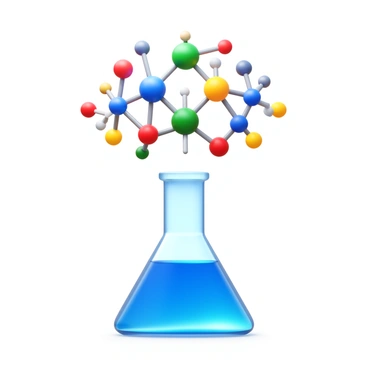
A cloud of compound molecules in various colors floating above a laboratory flask. The molecules are represented as interconnected spheres and rods, showcasing different atomic structures. The laboratory flask is made of transparent glass, filled with a bright blue liquid. The setting is well-lit, highlighting the clarity of the flask and the vivid colors of the molecules.A single helium atom depicted as a 3D icon in space. The design features two protons and two neutrons represented as spheres in a yellow color, surrounded by two electrons shown as smaller spheres in blue, orbiting around the nucleus. The background is a deep black, highlighting the atom's structure in a stark contrast. The overall composition emphasizes the isolated nature of the helium atom in the vastness of space.A mountain with distinct layers, each representing a different element. The base layer is rocky, showcasing "earth" with brown soil and gray stones. The next layer is filled with "water", featuring cascading blue streams and small ponds. Above that, a layer of "air" is depicted with flowing clouds and a light blue sky. The peak represents "fire", with orange and red hues and stylized flames. The overall mountain structure is prominently displayed against a contrasting background.A simple atomic structure is depicted with a central nucleus surrounded by orbiting electrons. The nucleus is represented as a solid sphere, with a mix of colors indicating different particles within it. Multiple electrons are shown as small spheres moving in circular paths around the nucleus, with varying distances between the nucleus and the electrons. The paths of the electrons are illustrated as faint circular lines indicating their orbits. The overall color scheme features gradient pastel shades, creating a harmonious appearance that highlights the atomic model.Trees with thick trunks covered in textured bark, branching out into vibrant green leaves. From the trunks, intricate compound molecular structures extend like branches, showcasing various atoms and bonds connecting in complex formations. The molecular structures are vividly colored, with some atoms represented in blue, red, and yellow, creating a striking contrast against the natural greens of the leaves. The scene captures the harmony between nature and science, with the trees standing tall and the molecular structures artistically intertwining around the branches.A detailed illustration of a crystalline structure depicting the arrangement of carbon atoms in a diamond form. The structure showcases a three-dimensional lattice, with each carbon atom represented as a small black sphere. These spheres are interconnected by rigid lines, symbolizing strong covalent bonds. The diamond's clarity is emphasized, allowing the geometric symmetry of the tetrahedral arrangement of the atoms to be clearly visible. Light reflections are captured to highlight the transparent nature of the diamond, enhancing the visual fidelity of the crystalline pattern. The background is kept simple to focus on the intricate details of the structure.A laboratory scene featuring a wooden bench filled with various glassware. A large round-bottom flask is placed on a Bunsen burner, with colorful liquids swirling inside. There are beakers filled with vibrant blue and green liquids arranged nearby. A scientist, wearing goggles and a white lab coat, carefully pours a bright yellow liquid from a graduated cylinder into the flask. Smoke is gently rising from the mixture as the scientist observes the reaction with a focused expression. Lab equipment such as pipettes, a mortar and pestle, and test tubes are scattered across the bench, completing the busy experimental atmosphere.A segment of the periodic table is displayed, showcasing a variety of elements. The metals are represented in one color, clearly distinguishable from the nonmetals, which are depicted in another color. The metals are identified in a gradient of blue shades, while the nonmetals are in a gradient of green shades. Each element is labeled with its symbol and atomic number. The layout is structured with rows and columns, emphasizing the organization of the elements.A 3D model depicting a water molecule, showcasing two hydrogen atoms and one oxygen atom. The oxygen atom is represented as a larger red sphere, while the two hydrogen atoms are smaller white spheres. Each atom is connected by thin black bonds to illustrate the molecular structure. The atoms are labeled with clear text: "O" for the oxygen atom and "H" for each hydrogen atom. The model is presented against a soft pastel background, enhancing the visual appeal of the compound.A balanced scale featuring a central beam supported by a fulcrum, with reactants on one side and products on the other. The left side of the scale displays various chemical reactants in distinct glass vials, labeled with their chemical formulas. The right side showcases colorful glass containers filled with the corresponding products, also labeled. The scale is perfectly horizontal, indicating a state of equilibrium. The background includes subtle hints of a laboratory setting, with beakers and pipettes positioned on a workbench.A molecule with a central atom represented as a large circle in blue, symbolizing one type of atom. Attached to this central atom is a smaller circle in red, representing a different type of atom. The two atoms are connected by a thin line indicating a bond. The molecule is set against a plain white background.A split-screen illustration contrasting a compound and a mixture. On the left side, a "compound" is depicted with a uniform structure, consisting of small, evenly arranged blue and green spherical molecules tightly bonded together. On the right side, a "mixture" is illustrated with varied components, showcasing distinct chunks of red, yellow, and blue solids scattered randomly among each other, with clear separations between each color. The background is minimal to emphasize the differences between the two sides.A colorful chart featuring an organized grid layout showcasing symbols of various elements from the periodic table. Each box in the grid is filled with a different vibrant color, creating a visually appealing contrast. Inside each box, the symbol of an element is displayed prominently in bold white text. The boxes are neatly arranged, and some contain small illustrations representing the element, such as a hydrogen atom for hydrogen or a small iron nail for iron. The chart has a playful border adorned with small icons related to science, like test tubes and beakers, enhancing the educational theme.A large mosaic art piece made up of various symbols representing different elements. The background features a vibrant, colorful design made with small, shiny tiles. In the center, a bold symbol for "fire" is depicted with red and orange tiles, radiating warmth. To the left, a blue symbol for "water" is created using smooth, wavy tiles in shades of blue and turquoise. On the right, a green symbol for "earth" is represented with earthy-toned tiles, resembling leaves and hills. Above, a yellow symbol for "air" is formed with light, swirling tiles that create a sense of movement. The entire mosaic is bordered with a decorative pattern made of smaller, vibrant tiles that tie the elements together.Two atoms of the same element, represented as large spheres, are approaching each other in a vibrant, high-energy environment filled with swirling energy waves. Bright, dynamic lines connect the atoms, indicating their interaction and the release of energy as they begin to fuse. The background is filled with a gradient of pastel colors, transitioning from deep blues to radiant yellows, creating a sense of motion and intensity. Small bursts of light and energy particles radiate outward from the point of fusion, enhancing the dramatic effect of the atomic reaction.A group of workers, wearing blue safety helmets and orange vests, is focused on constructing a large molecule using smaller atomic 'bricks'. Each worker is engaged in a different task: one is carefully aligning the bricks, another is using a tool to secure them in place, and a third is holding up a large blueprint that outlines the structure of the molecule. The bricks are colorful, with distinct patterns and labels, symbolizing different types of atoms. The scene is set in a bright, well-organized construction area filled with scaffolding and tools. In the background, various molecular models and diagrams are displayed on the walls, illustrating the complexity of the work being carried out.A grouping of noble gases represented by distinct, minimalist cartoon illustrations. Each gas is depicted as a colorful, round orb. The helium orb is light yellow, the neon orb is bright orange, the argon orb is pale blue, the krypton orb is light green, the xenon orb is purple, and the radon orb is dark red. The orbs are arranged in a circular pattern, each orb labeled with its name in simple, bold lettering above it.A single atom is depicted as a simple circle, representing its nucleus, surrounded by a few small circles indicating electrons in orbit. In contrast, a molecule is illustrated as a larger shape made up of multiple circles interconnected by lines, showcasing the connections between the atoms. Each circle in the molecule represents a different atom, and the lines signify the bonds holding them together. The single atom is placed on one side, while the molecule occupies the other side for clear comparison.A detailed diagram illustrating atoms forming a covalent bond is presented. The image features two distinct atoms, one depicted in blue and the other in red, positioned close to each other. Each atom is represented with a nucleus at the center, shown as a small circle, surrounded by a cloud of electrons depicted as small dots orbiting around the nucleus. A pair of electrons, represented as overlapping dots between the two atoms, signifies the shared electrons in the covalent bond. Clear labels identify each atom and highlight the shared electrons, enhancing the educational aspect of the diagram.A collection of colorful compound molecules, each designed like a distinct puzzle piece. The molecules feature various shapes and sizes, with intricate bonds and connections visible between them. Some pieces are hexagonal, others are triangular and circular, all crafted in vibrant blues, greens, oranges, and purples. The molecules are interlocking seamlessly to form a larger, coherent structure, emphasizing the theme of unity in diversity. Light reflects off their surfaces, highlighting the details of their chemical structures and creating a visually appealing arrangement that showcases their compatibility.Several spheres of varying sizes are arranged in a dynamic composition. The largest sphere is a deep blue with swirling white patterns reminiscent of ocean waves. Next to it, a medium-sized red sphere features a bold checkerboard pattern in black and white. A smaller green sphere is covered in tiny yellow polka dots, while another small sphere, colored in vibrant orange, has spiral stripes in a lighter shade of orange. The arrangement creates a sense of depth, with some spheres partially overlapping and casting soft shadows on a neutral background.A step-by-step diagram showing a simple chemical reaction process. The first step illustrates two reactants: a colored liquid in a beaker and a solid powder next to it. The second step depicts the solid powder being poured into the beaker containing the colored liquid, creating a swirl effect. The third step shows the mixture bubbling and changing color as the reaction occurs. The final step displays the resulting product, a clear liquid, in the beaker, with an arrow indicating the direction of the reaction.A vibrant rainbow composed of seven distinct colored arcs, each representing a different element with its unique symbol. The first arc is red, showcasing a flame symbol. The second arc is orange, displaying a swirling wind symbol. The third arc is yellow, featuring a sun symbol. The fourth arc is green, representing a tree symbol. The fifth arc is blue, exhibiting a water droplet symbol. The sixth arc is indigo, illustrating a crystal symbol. The seventh arc is violet, highlighting a mountain symbol. Each arc has a glossy finish, reflecting light vividly, and the entire rainbow is set against a clear blue sky.A 3D render illustrating the repeating lattice structure of a metallic element. The scene features a series of interlocking atoms represented as small spheres, each atom colored in shades of silver and gray. The spheres are connected by straight metallic bonds, creating a geometric pattern that extends in three dimensions. The background is a subtle gradient that enhances the visibility of the lattice structure. The arrangement showcases the symmetry and regularity of the lattice, with various angles presented for a comprehensive view.A detailed diagram illustrating electron orbitals surrounding an atomic nucleus. The central atomic nucleus is represented as a small sphere, varied in color to indicate protons and neutrons. Surrounding the nucleus are different electron orbitals depicted as various shapes: spherical s-orbitals, dumbbell-shaped p-orbitals, and more complex d-orbitals, each clearly labeled with their respective designations. The orbitals are drawn in different colors to distinguish them from one another, and the arrangement of the orbitals shows their spatial orientation around the nucleus.A detailed illustration of two distinct molecules engaged in a chemical reaction. The first molecule is a vibrant blue sphere representing a water molecule connected by two hydrogen atoms, and the second molecule is a bright red and yellow sphere symbolizing a carbon dioxide molecule composed of one carbon atom and two oxygen atoms. The two molecules are approaching each other, with arrows indicating a bond forming between them. Additionally, there are small sparkles around the area of interaction to signify the reaction taking place.A solid block is positioned in the center of the image, representing a pure element. The block has a smooth surface and clearly defined edges. Engraved on the front face of the block is its symbol, "Fe", denoting iron. The symbol is bold and centered for visibility. The overall presentation showcases the simplicity and clarity of the element's representation, emphasizing the block’s solid and robust nature.A simple diagram illustrates multiple water molecules represented as "H₂O" with two hydrogen atoms and one oxygen atom. Lines are drawn between the oxygen atom of one water molecule and the hydrogen atoms of adjacent water molecules, symbolizing "hydrogen bonds." Each water molecule is shown in a stylized format with the oxygen atom in red and hydrogen atoms in white. The hydrogen bonds are depicted as dashed lines to indicate their weak, temporary nature. The background is a light blue color to suggest a watery environment.A collection of colorful balloons filled with noble gases, such as helium, neon, argon, krypton, xenon, and radon, is floating gracefully above a detailed periodic table. The balloons, varying in size and vibrant in color, are tethered by thin strings that catch the light. The periodic table underneath is arranged in an organized grid, with each element clearly labeled, showcasing the atomic numbers and symbols. The balloons create a sense of whimsy above the scientific structure of the periodic table, enhancing the visual contrast between the light, airy balloons and the structured, informative layout below.A large chalkboard is positioned in a bright classroom. The black surface displays a simple chemical equation written in white chalk. On the left side of the equation, there are two reactants, "A + B," illustrated as colorful, cartoon-style molecules with smiling faces. They are positioned next to each other with arrows drawn between them. The right side of the equation showcases the products, "C + D," represented by cheerful, vibrant molecules also smiling and appearing lively. The whole scene conveys a sense of playful science, with small stars and sparkles surrounding the equation to emphasize the transformation from reactants to products.
В сообществе ничего не найдено