Coriolis effect

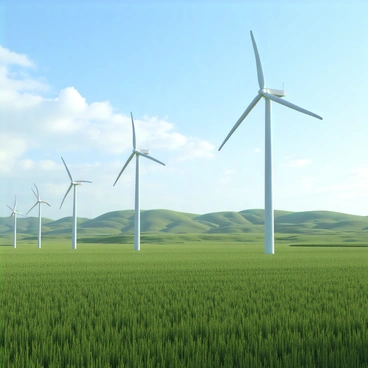
A vast field of wind turbines extends across the landscape, each turbine standing tall with three long, slender blades. The turbines are painted white and positioned in perfect alignment to capture the winds. The sky above is a clear blue, with a hint of fluffy white clouds scattered throughout. The grass in the field is a rich green, gently swaying in the breeze. The background features rolling hills that gradually rise, creating a picturesque panorama. The turbines rotate gracefully, harnessing energy from the winds that have been redirected by the Coriolis effect.A sky filled with fluffy white clouds in varying shades of gray and white, moving across a bright blue background. The clouds are depicted in an array of sizes, with some appearing larger and more puffy while others are wispy and elongated. The motion of the clouds is illustrated to show a swirling pattern, demonstrating the deflection caused by the Coriolis effect. Light streams through gaps between the clouds, creating highlights and shadows that enhance their three-dimensional appearance.An aerial view captures a formation of intricate cloud vortices swirling in the atmosphere. The clouds display varying shades of white and gray, with some having a soft, fluffy appearance while others appear thin and wispy. The patterns of the vortices create a dynamic sense of movement, as they twist and spiral in different directions. Bright sunlight filters through some of the clouds, casting gentle shadows on the atmosphere below. The overall scene conveys the fascinating interplay of wind patterns and atmospheric conditions.A rocket is positioned on a launch pad, ready for takeoff. The rocket is painted with distinct markings and has a streamlined design. Surrounding the launch pad, there are several tall structures, including a control tower and fuel tanks. As the rocket ignites, flames and smoke erupt from its base, creating a dynamic scene. 

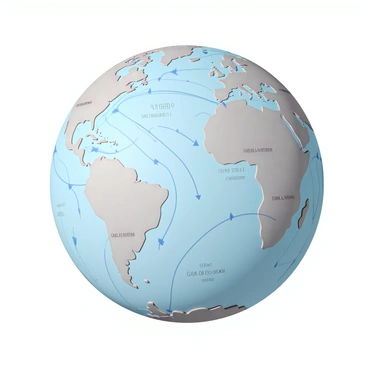
In the sky, curved paths are illustrated to demonstrate how the Coriolis effect influences the rocket's trajectory. These paths are drawn in clear lines, showing the trajectory bending due to Earth's rotation. A grid pattern is visible in the background, providing context to the trajectory's path. There are faint clouds scattered in the sky, complementing the visual of the rocket launch.A laboratory setup features a large transparent glass container divided into two hemispheres. Each hemisphere is filled with clear water. In the left hemisphere, the water is swirling in a clockwise direction, creating small whirlpool patterns. In the right hemisphere, the water is swirling counterclockwise, producing contrasting whirlpool motions. Various laboratory equipment, such as beakers and pipettes, are arranged neatly on a nearby countertop. The background includes shelves filled with scientific books and containers, enhancing the laboratory atmosphere.A detailed map of the Northern Hemisphere, prominently displaying the effects of the Coriolis effect on wind and ocean currents. The map features a clear background with labeled wind patterns, such as trade winds and westerlies, illustrated in curved arrows indicating their directions. Ocean currents are represented with flowing lines in various shades of blue, depicting warm and cold currents like the Gulf Stream and the California Current. The Earth's continents are accurately outlined, providing context to the currents and winds, with geographic markers indicating key locations. The overall presentation is scientifically informative, with a focus on visual clarity and geographic accuracy.A 3D icon depicting the surface of the Earth with continents and oceans. The Earth is shown with arrows and lines illustrating the deflection of moving objects, indicating the Coriolis effect. The arrows curve around the globe, demonstrating the impact of rotation on movement. Different colors are used for the arrows to distinguish between various directions of deflection. The lines are dynamic, showing the motion and flow of objects across the Earth's surface.A ship's captain is standing on the deck of a large ship, carefully examining a large, unfolded map. The captain is wearing a navy blue captain's uniform with gold insignia, and a captain's hat rests on their head. The map is spread out on a wooden table, displaying a detailed sea route with lines that illustrate the effects of the Coriolis effect. In the background, the ocean is visible, with gentle waves and a clear sky. A compass is placed next to the map, and a telescope is propped up against the side of the ship. The captain’s expression is focused as they mark the map with a green pencil, tracing the course with precise movements.A blue and white illustration depicts the Earth spinning on its axis. The Earth is shown as a sphere with visible continents and oceans. Arrows representing wind flow are illustrated around the globe, with some arrows curving to indicate the Coriolis effect. The arrows are differentiated by their direction, with some moving clockwise and others counterclockwise, demonstrating how the Coriolis effect influences wind patterns. The background is plain to emphasize the Earth and the wind arrows.An illustration depicting fluid dynamics within a large, transparent container filled with water. The container has a rectangular shape and is placed upright to clearly display the interior. Inside, the water exhibits swirling flow patterns that demonstrate the Coriolis effect. The flow is visualized with arrows indicating the direction of movement, creating circular currents that spiral in a distinct manner. Bubbles rise to the surface, and subtle ripples can be seen throughout the water, enhancing the representation of motion and flow.An aviation chart displaying various flight paths with arrows indicating adjustments made for the "Coriolis effect." The chart includes a grid overlay, detailed geographical features, and compass rose symbols. Color-coded lines represent different altitudes and routes, with annotations explaining the impact of the Coriolis effect on navigation. The background features a clear blue representation of the sky.A large Foucault pendulum is suspended from a high ceiling in a museum hall. The pendulum features a heavy round weight at the end of a long, thin rod, which sways gently back and forth. The pendulum's path is marked on the polished wooden floor beneath it with a circular pattern, indicating the motion as it demonstrates the Coriolis effect. Surrounding the pendulum are groups of interested visitors observing its movement, some taking pictures. The museum walls are adorned with educational displays about physics and the Coriolis effect, featuring diagrams and text. Natural light streams in through tall windows, illuminating the scene.A detailed diagram showing global atmospheric circulation patterns. The diagram highlights the Coriolis effect with swirling arrows indicating wind direction in both hemispheres. It features the equator prominently in the center, with ascending and descending air currents illustrated using different colors. There are labels for the trade winds, westerlies, and polar easterlies positioned accordingly around the globe. The continents and oceans are represented accurately, providing a contextual background to the atmospheric patterns.An Earth globe is displayed prominently in the center. The globe features detailed topographic elements, including continents and oceans. Around the globe, there are several colorful arrows illustrating the rotation direction of the Earth, with one arrow going clockwise around the equator. Additionally, other arrows are showing the Coriolis effect on wind patterns, bending to the right in the Northern Hemisphere and to the left in the Southern Hemisphere. The background is simple to ensure the focus remains on the globe and the arrows.A blue diagram of global wind patterns features curved arrows representing different wind currents on the Earth. Each arrow is labeled clearly with its corresponding wind name, such as "Trade Winds" and "Westerlies." The arrows illustrate how the Coriolis effect causes the winds to curve to the right in the Northern Hemisphere and to the left in the Southern Hemisphere. There are directional indicators that emphasize the changes in wind direction due to the Coriolis effect, and the background of the diagram is white, providing contrast to the blue arrows and labels.A world map displayed in a flat format. The map features arrows in various colors, each indicating the general deflection of air currents. The arrows point in different directions across continents and oceans. The arrows are labeled with "Coriolis effect" for clarity. The oceans are depicted in blue, with landmasses in green and brown. The entire map is detailed and clear, highlighting the global patterns of airflow.An ocean map displaying various shades of blue to illustrate different depths of the ocean. The map features major ocean currents depicted with bold arrows in different colors. Each arrow indicates the direction and influence of the Coriolis effect on these currents. The continents are shown in muted earth tones, with labels identifying key locations. The background includes subtle grid lines to aid in navigation. The overall composition is informative and educational, designed to highlight oceanographic dynamics.A colorful world map showcasing the trade winds with arrows indicating their flow direction. The trade winds are marked in shades of blue and green, highlighting their patterns across the globe. Additional arrows represent the Coriolis effect, swirling around the map and demonstrating how it influences wind direction. The outline of continents is clearly defined in a vibrant color, providing contrast to the background. Key latitude lines are labeled with clear text, enhancing the educational aspect of the illustration.An object in motion moving straight along the equator, depicted with arrows indicating the direction of movement. The object is shown as a sleek, aerodynamic shape, possibly resembling an aircraft or a bullet. The arrows are bold and clearly outlined, emphasizing the absence of Coriolis deflection, demonstrating a straight path. The background features a stylized representation of the Earth with latitude lines, enhancing the equatorial context.A modern pastel illustration depicting a long-distance projectile in motion. The projectile is marked with a bright color, such as red, to emphasize its trajectory. A curved path is illustrated behind it, showing the effect of the "Coriolis effect" with a smooth arc. In the background, a stylized globe is visible, with lines of latitude and longitude marked clearly. Surrounding the globe are arrows indicating wind direction and rotation, enhancing the depiction of the Earth's rotation influencing the projectile's path.A detailed weather map is displayed prominently. The map features various pressure systems illustrated as blue and red circles, indicating high and low-pressure areas respectively. Arrows with varying thickness and color demonstrate the movement of these pressure systems across the map. A subtle spiral pattern is evident, showcasing the influence of the Coriolis effect on the direction of the winds. Various colored lines indicating isobars crisscross the map, creating a complex network. In the corners, small icons represent weather conditions like rain, sun, and clouds.A satellite view of a hurricane displayed from above, showcasing the swirling cloud formations in varying shades of gray and white. The eye of the hurricane is clearly visible at the center, surrounded by a thick band of clouds. Arrows are represented around the hurricane, indicating the direction of the Coriolis effect on its rotation. The arrows are colored in blue and green for contrast, pointing in a circular motion to emphasize the rotation of the storm. The background is a deep blue, representing the ocean beneath the hurricane.A close-up view of water spiraling down a drain. The water is captured in motion, creating a visible whirlpool pattern as it descends. The drain itself is circular, with a metallic texture, and is surrounded by a green-and-purple outlined rim. The water has detailed reflections, showing the movement and direction clearly as it forms a spiral. The surface of the water features small bubbles and ripples that emphasize the dynamic flow. Overall, the scene focuses on the intricate details of the water's movement as it drains.A tornado is depicted forming in a field. The tornado has a narrow, spiraling shape with a funnel extending from the clouds to the ground. Surrounding the tornado are arrows, clearly indicating the influence of the Coriolis effect. These arrows curve around the tornado, showing the direction of rotation and movement. In the background, there are scattered clouds and a horizon line, enhancing the sense of depth in the scene. The ground below is a flat landscape with some grass and scattered debris.A blue airplane cockpit is filled with various instruments and controls. A pilot, wearing a white uniform and a black cap, is seated at the controls, focused on adjusting the navigation system. The cockpit window shows a clear sky with a few white clouds scattered. On the dashboard, colorful dials and screens display information, including coordinates and flight data. The pilot's hands are positioned on a navigation panel, manipulating the settings while a map is visible in the background, indicating flight paths and waypoints.A detailed cross-section of Earth's atmosphere is illustrated, showcasing various atmospheric layers such as the troposphere, stratosphere, and mesosphere. The troposphere is depicted in shades of blue, transitioning to lighter tones in the stratosphere. Jet streams are clearly represented as flowing lines in contrasting colors, moving from west to east across the globe. Arrows indicate the direction and influence of the Coriolis effect on these jet streams, curving as they travel. Labels are included for each atmospheric layer and the jet streams, with the words "Coriolis effect" prominently displayed near the arrows. The background is a gradient transitioning from light to darker hues to emphasize the depth of the atmosphere.A detailed cross-section diagram of the Southern Hemisphere showing a cyclone. The cyclone is depicted with swirling winds and rain bands, creating a dynamic motion around a central eye. Arrows are prominently illustrated, indicating the direction of the Coriolis effect, which shows the rotation of wind around the cyclone. The arrows curve to the left, emphasizing the counterclockwise rotation characteristic of cyclones in this hemisphere. The background features a gradient representing the atmosphere, with blue tones to suggest the sky and lighter colors to illustrate cloud formations.A 3D model of "Earth" is prominently displayed in the center of the image. The Earth features geographical details, including continents and oceans. Surrounding the model, rotating arrows are illustrated, showcasing the movement patterns associated with the Coriolis effect. These arrows are positioned to indicate the direction of rotation across different hemispheres. Text labels are clearly positioned nearby, with phrases such as "Coriolis Effect" and additional explanations, designed to enhance understanding. The overall composition is balanced and organized, making the scientific concept visually accessible.A diagram illustrating the structure of a cyclone, featuring a central eye surrounded by swirling clouds. The outer section displays a series of arrows, clearly indicating the Coriolis-induced rotation. Each arrow is curved to illustrate the direction of the wind movement, creating a dynamic appearance. The cyclone structure is detailed with layers of clouds, showing varying shades of gray and white. Labels for different parts of the cyclone, such as "eye," "eyewall," and "rainbands," are positioned around the diagram for clarity.
В сообществе ничего не найдено