Sodium potassium pump

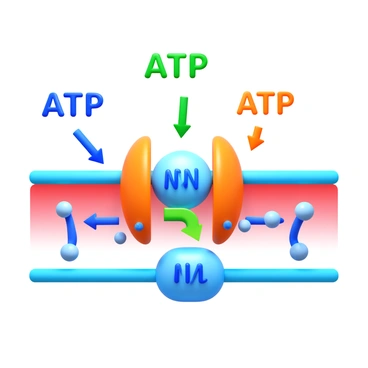
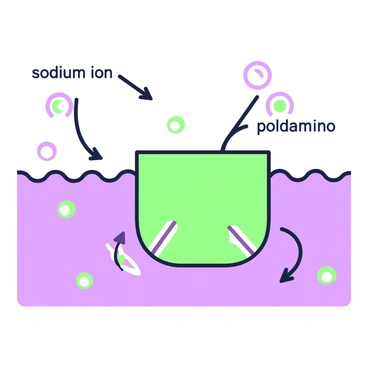
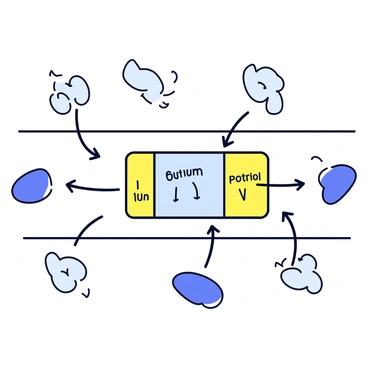
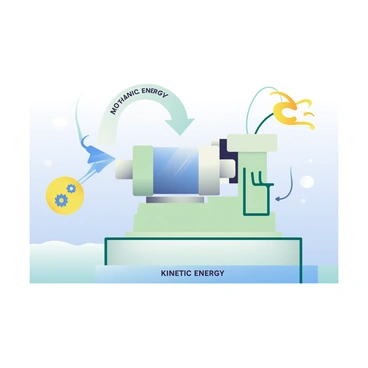
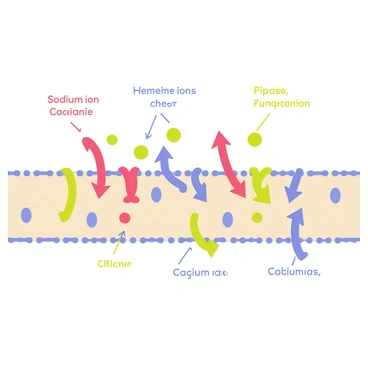
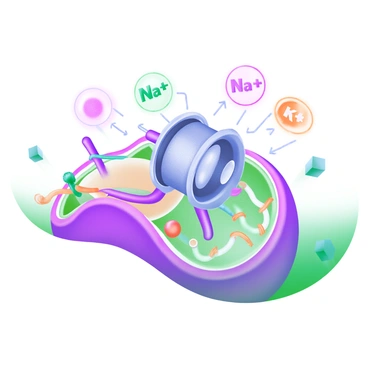
A large factory interior is filled with machinery designed to process ions. In the center, there is a long, industrial conveyor belt where various pumps are arranged in a row, each labeled with different chemical symbols. The pumps have shiny metallic surfaces and are connected with thick tubes that carry colorful liquids. Bright overhead lights illuminate the scene, highlighting the details of the machinery and the vibrant colors of the liquids being processed. Multiple large windows reveal a view of a blue sky outside, and several workers in blue coveralls are observing the process with focused expressions.A sodium-potassium pump depicted as a detailed 3D icon, showing a membrane structure with embedded proteins. The pump is illustrated actively transporting "sodium ions" represented in blue moving out of the cell and "potassium ions" represented in orange moving into the cell. The background displays a gradient representing the cellular environment. Arrows indicate the direction of ion movement, emphasizing the pump's function as an essential life support system for cells. The entire structure is rendered with a focus on clarity and dimensionality, highlighting the intricate details of the proteins and ion exchanges.A large, abstract representation of a sodium-potassium pump is depicted as a mechanical engine within a cell. The engine is made of metallic components with tubes and pistons, symbolizing the movement of sodium and potassium ions. Bright blue sodium ions are moving out of the engine while vibrant yellow potassium ions are entering, creating a flow of energy. Surrounding the engine, there are soft cellular structures with a light gradient texture representing the cell membrane. Small, glowing arrows illustrate the direction of ion movement, highlighting the pump's function in maintaining cellular balance.A cartoon illustration of a city scene depicting busy traffic with colorful cars and trucks moving along the roads. In the center, a large and simplistic representation of a sodium-potassium pump is shown, with arrows indicating the movement of ions. On one side, a group of blue cars represents sodium ions, moving towards the pump, while on the other side, a group of green cars symbolizes potassium ions, traveling away from the pump. The background features tall buildings and traffic lights, enhancing the sense of a bustling urban environment.A colorful representation of "ATP" molecules being utilized in the "sodium-potassium pump process." The image features several "ATP" symbols in bright colors, illustrating the energy transfer. There are "sodium" ions depicted in blue and "potassium" ions in orange, showing their movement through a 3D membrane. A detailed depiction of the pump mechanism is present, showcasing the transport of "sodium" out of the cell and "potassium" into the cell, highlighting the energetic exchange facilitated by "ATP."A dynamic scene depicts a scientific illustration of ions flowing through a pump in action. The pump is shown in the center, with a metallic casing and bright blue accents. Colorful ions, represented as small spheres, are moving rapidly through transparent tubes connected to the pump. The ions are depicted in various colors, including red, green, and yellow, illustrating different types of ions. There are motion lines around the ions to emphasize their flow. The background is a soft gradient transitioning from light blue at the top to white at the bottom, enhancing the focus on the pump and the flowing ions.A balanced scale is positioned at the center of the image, depicting the concept of equilibrium. On the left side of the scale, there is a representation of "sodium ions" illustrated as small green spheres, carefully balanced on a green platform. On the right side, "potassium ions" are shown as slightly larger purple spheres, equally balanced on a purple platform. Above the scale, a clear label reads "Equilibrium" in prominent font. The background is minimal to emphasize the scale and the ions, allowing the viewer to focus on the concept being represented.A detailed network diagram illustrates the interaction of various molecules within a cell's membrane. Central to the diagram is a prominent "pump" structure, depicted as a stylized protein embedded in the membrane. Surrounding the pump are different colored molecules, representing ions and other substrates, connected by lines that indicate their interactions. The membrane is outlined, showing its lipid bilayer, with a gradient transition from light to dark shades along its edges. Labels for each molecule and arrows indicating the direction of flow between them enhance the clarity of interactions within the network.A detailed 3D model of a sodium-potassium pump is displayed prominently. The pump is depicted with distinct labels for various parts: the "sodium binding sites" are highlighted in one area, while the "potassium binding sites" are shown in another. Pathways are illustrated, indicating the movement of sodium and potassium ions across the membrane. The pump's overall structure is clearly defined, showcasing its configuration and orientation in relation to the surrounding cell membrane. The labeled components provide clear identification of the "ATP binding site" and other important areas of the pump.An illustration of the sodium-potassium pump with ions in motion. The pump is depicted as a rectangular structure embedded in a cell membrane. On one side of the pump, there are "sodium ions" represented by small circles, and on the opposite side, there are "potassium ions," also represented by small circles. The sodium ions are shown moving away from the pump while the potassium ions are moving towards it. Arrows illustrate the direction of movement, creating a dynamic flow. The background is a simple representation of the cell membrane, providing context for the movement of ions.An illustration depicting the sodium-potassium pump in action at a cellular membrane. The membrane is shown with a series of proteins embedded within it. On one side of the membrane, there are several "sodium ions" in green, and on the opposite side, several "potassium ions" in purple. The sodium ions are moving from the inside of the cell to the outside, while the potassium ions are moving from the outside to the inside. Arrows indicate the direction of the ion movement, highlighting the exchange process. The pump itself is stylized with a defined structure, showcasing the mechanism of ion transport across the membrane.A detailed illustration of the "sodium-potassium pump," showcasing the process of electrical potential changes across a cell membrane. On one side of the membrane, depict "sodium ions" in blue being transported out of the cell, while on the other side, show "potassium ions" in red being brought into the cell. Include an arrow indicating the direction of ion movement. Illustrate the cell membrane with embedded pump proteins, and represent the changes in electrical potential with color gradients, transitioning from negative to positive across the membrane. Add labels for key components, such as "sodium ions," "potassium ions," and "cell membrane."A 3D icon of a sodium-potassium pump embedded in a cell membrane. The pump is depicted as a protein structure with two distinct sides. On one side, "sodium ions" are shown being transported out of the cell, depicted in blue. On the other side, "potassium ions" are shown being transported into the cell, depicted in red. The surrounding cell membrane is illustrated with a textured surface, emphasizing its semi-permeable nature. Arrows indicate the movement of ions, highlighting the active transport process occurring within the cellular environment.A modern pastel illustration depicting an infographic on the efficiency of "sodium-potassium pumps." The center features a large diagram of a sodium-potassium pump, with arrows indicating the movement of sodium ions and potassium ions across a cell membrane. Surrounding the pump are labeled sections detailing the process and benefits, including "3 sodium out," "2 potassium in," and "energy efficiency." Additional graphics include an energy symbol and a stopwatch, representing the quick action of the pump. The background is softly blended in pastel shades to enhance the readability of the information displayed.An educational poster featuring various proteins, including a detailed illustration of the "sodium-potassium pump." The sodium-potassium pump is depicted in the center, highlighting its structure and function with arrows indicating the movement of sodium and potassium ions. Surrounding it are representations of other proteins, such as enzymes, receptors, and transport proteins, each labeled with their names. Colorful diagrams and annotations explain their roles in cellular processes, creating an informative and visually engaging layout. The background is a soft pastel color to enhance readability and appeal.An illustration depicting a sodium-potassium pump embedded in a cell membrane. The pump has a rectangular shape with distinct sections labeled "sodium" and "potassium." Sodium ions are shown moving from the outside of the cell into the pump, while potassium ions are moving from the inside of the pump to the outside of the cell. Small arrows indicate the direction of ion movement. Surrounding the pump, there are simplistic representations of the cell membrane and nearby cells to suggest the concept of cellular communication. Each element is outlined clearly for clarity.A detailed cycle diagram is presented, illustrating the lifecycle of ions through the sodium-potassium pump. In the center, there is a representation of the sodium-potassium pump, which is depicted as a complex protein structure. Two blue sodium ions are shown being transported out of the pump towards the top of the diagram, while three orange potassium ions are entering the pump from the bottom. Arrows indicate the movement of ions, with labeled pathways demonstrating "Sodium out" and "Potassium in." Background elements include a soft gradient transitioning from light blue at the top to light green at the bottom, emphasizing the biological context. Labels for each stage within the cycle are placed strategically around the diagram, clearly outlining the process of ion exchange.An illustration depicting a pump in operation is at the center of the image. The pump is shown with clear labels indicating its different components, such as the inlet, outlet, and motor. There are arrows indicating the flow of water entering the pump from the left, labeled "mechanical energy" as it moves through the pump. As the water is expelled from the outlet on the right, it is labeled "kinetic energy." Additionally, there are small icons representing energy transformation: a gear for mechanical energy, and a water wave for kinetic energy. The background features a gradient that transitions from light blue to light green, enhancing the clarity of the energy transformation process.A vibrant illustration depicting the transport of ions within a cell. The image features several colorful arrows representing different pathways for ion movement. Each pathway is color-coded, with red arrows symbolizing sodium ions, blue arrows for potassium ions, and green arrows indicating calcium ions. The background consists of a simplified cell membrane with embedded proteins, highlighting the points where ions cross the membrane. Various small circles represent the ions themselves, moving along their specific pathways. Labels appear next to each colored pathway, clearly identifying the ions being transported.A modern pastel illustration depicting a sodium-potassium pump embedded in a cell membrane. The pump is represented as a dynamic, intricate structure with clear, flowing lines and vibrant colors that highlight its functionality. Surrounding the pump are various ions, with "Na+" and "K+" labels, moving in and out of the cell, illustrating the active transport process. The background includes stylized representations of cell organelles, emphasizing the role of the pump in maintaining cell homeostasis.A detailed depiction of the protein structure forming the "sodium-potassium pump" is displayed with a three-dimensional view of the protein complex. The pump is represented with a central channel that has a blue hue, surrounded by multiple helices colored in green and yellow. Sodium ions are depicted as small spheres in a darker shade, showing their movement towards one side of the pump. Potassium ions are shown as slightly larger spheres in a lighter shade, indicating their movement towards the opposite side. The entire structure is anchored into a stylized lipid bilayer colored in light pink, with highlighted sections indicating the flow of ions across the membrane. "Sodium-Potassium Pump" is labeled clearly in a readable font above the structure.A detailed cross-section diagram of a cell membrane is displayed. The cell membrane is represented with a fluid mosaic model, highlighting phospholipid bilayers in shades of blue and yellow, with embedded proteins. Prominently featured is the "sodium-potassium pump," depicted as a large transmembrane protein. The pump is illustrated in its active state, with three "sodium ions" shown being transported out of the cell and two "potassium ions" being transported into the cell. Arrows indicate the direction of ion movement, with a small ATP molecule shown nearby, representing energy use. Surrounding the membrane, there are various cell structures, such as ribosomes and endoplasmic reticulum, providing context to the diagram.A series of comic-style frames illustrating the "sodium-potassium pump cycle." The first frame shows a cell membrane with sodium ions in blue and potassium ions in orange, positioned outside the membrane. The second frame depicts the sodium ions being transported into the cell, with arrows indicating movement. The third frame illustrates the active transport process, where energy in the form of ATP is represented by a glowing, yellow symbol. The fourth frame shows potassium ions being moved back outside the cell, completing the cycle. Each frame includes dialogue bubbles with labels: "Sodium in!" and "Potassium out!" to enhance understanding of the cycle.A group of colorful ions, represented as small spheres, approaching a detailed ion pump structure. The ions exhibit various colors, such as red, blue, green, and yellow, reflecting different types of ions. The ion pump appears as a complex, intricate machine set against a simple background. Some ions are shown in motion, racing towards the opening of the pump, while others are slightly behind, creating a sense of competition. The pump itself has a metallic, sleek design with indicators and lights suggesting its operational status.
В сообществе ничего не найдено