Rough endoplasmic reticulum

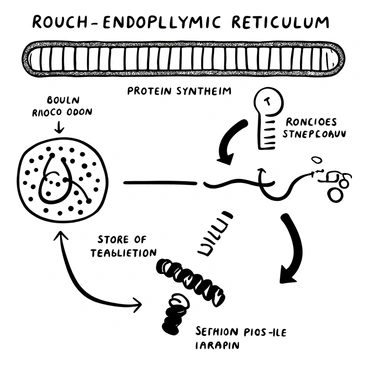
A landscape depicting a cellular terrain with vibrant colors and textures. The rough endoplasmic reticulum is illustrated as a wide, flowing river with a textured surface that resembles the ribosome structure along its banks. Surrounding the river are various cellular structures such as mitochondria designed as mountains in the background and golgi apparatus appearing as clusters of trees. The terrain is filled with intricate details, showcasing other organelles and components that create a dynamic and engaging environment.A whimsical illustration of a harbor scene representing the rough endoplasmic reticulum. In the center, there is a large dock with several ships labeled with the names of different proteins. Workers, depicted as small figures, are busily assembling protein structures on the docks. There are cranes lifting large packages of proteins onto the ships, while others are guiding smaller boats into their designated spots. Surrounding the harbor are curved green and purple waves, emphasizing the dynamic nature of this protein assembly site. In the background, there are tall buildings resembling ribosomes, adding to the bustling harbor atmosphere.A detailed illustration of the rough endoplasmic reticulum depicted as a complex network of folded membranes. The rough endoplasmic reticulum has ribosomes attached to its surface, making it appear textured. It weaves through a dense cytoplasm filled with various organelles, including spherical mitochondria and elongated Golgi apparatus, each exhibiting distinct shapes and structures. Some small vesicles are also present, floating in the cytoplasm, creating a dynamic cellular environment.A detailed visualization of ribosomes attached to the surface of the rough endoplasmic reticulum, characterized by its ribbed appearance. The ribosomes are small, spherical structures, visible in clusters along the membrane of the endoplasmic reticulum. Emerging from these ribosomes are elongated protein chains, illustrated as bright, folded structures extending outward. The scene captures the intricate relationship between ribosomes and the endoplasmic reticulum, depicting the process of protein synthesis in a biological context. The overall color palette includes soft blues and greens for the organelles, contrasted with vibrant hues for the protein chains.A scientist wearing a lab coat is standing at a laboratory bench, intently looking through a microscope. The microscope is positioned in front of a detailed diagram of a cell displayed on a screen, with the "rough endoplasmic reticulum" highlighted prominently in a contrasting manner. The laboratory is filled with various scientific instruments, beakers, and test tubes, creating an environment of active research and discovery. There are stacks of textbooks and notes scattered around, emphasizing the focus on scientific study.A science classroom scene filled with students gathered around a large table. On the table, there is a detailed 3D model of the "rough endoplasmic reticulum," showcasing its intricate structure with ribosomes attached to its surface. Students are standing and sitting, some taking notes in their notebooks, while others are pointing at different parts of the model. At the front of the room, a teacher is explaining the functions of the rough endoplasmic reticulum, holding a pointer. The classroom is equipped with shelves filled with scientific books and posters depicting cell structures on the walls. A couple of students are engaged in a discussion, while a window allows natural light to fill the room.A vibrant collage depicting the rough endoplasmic reticulum with its distinct ribosomes attached to the surface, showcasing its intricate network of membranes. Next to it, several mitochondria with their oval shape and internal folds are visible, symbolizing energy production. Also included are lysosomes, represented as small, spherical structures with a slightly textured surface. The background features various colors that enhance the details of each organelle, creating a dynamic and educational representation of cellular components.A cell is situated in the vastness of space. The cell membrane is clearly defined, showing a complex structure. Within the cell, the rough endoplasmic reticulum is prominently visible, exhibiting a network of folded membranes. It appears to be glowing, with details that emphasize its texture and shape. Small vesicles are emerging from the rough endoplasmic reticulum, representing the production of proteins. The surrounding environment features various floating cellular structures, adding depth to the scene. The vastness of space forms a dramatic backdrop, with stars scattered in the distance.A close-up view of the rough endoplasmic reticulum is depicted, showing its textured surface. Ribosomes are attached to the outer membrane, actively synthesizing proteins. Each ribosome is visibly translating strands of mRNA, highlighted by the presence of amino acids being linked together. Small vesicles are emerging from the endoplasmic reticulum, indicating the transport of newly formed proteins. Cytoplasm surrounds the organelle, with various other cellular components subtly blending into the background.An illustration of a healthy cell with a clear structure. The cell membrane surrounds the cell, providing a defined boundary. Inside, there is a prominently displayed rough endoplasmic reticulum, characterized by its ribosomes attached to the surface. These ribosomes are depicted as small dots along the membranes of the rough endoplasmic reticulum, indicating sites of protein synthesis. The endoplasmic reticulum is shown as an extensive network of folded membranes, highlighting its role in cellular activity. Surrounding the rough endoplasmic reticulum, there are several other organelles visible, such as mitochondria and a nucleus, contributing to the overall complexity of the cell. The nucleus is shown with a double membrane and pores, indicating its function in housing genetic material.A modern pastel illustration of an animal cell, prominently displaying the "rough endoplasmic reticulum" in a vibrant, labeled format. The rough endoplasmic reticulum is textured with ribosomes visible on its surface, highlighted in a pastel shade of blue. Other organelles are depicted, including a "nucleus" in purple, "mitochondria" in orange, and "Golgi apparatus" in pink. Each organelle is clearly labeled with colorful text. The background features soft, blended pastels to enhance the overall presentation without drawing attention away from the details of the cell.An educational poster featuring the rough endoplasmic reticulum vividly illustrated in the center. The rough endoplasmic reticulum is depicted as a series of interconnected membranes with ribosomes attached, giving it a textured, bumpy appearance. Around the central image, vibrant sections display fun facts about its functions, such as "Involved in protein synthesis" and "Acts as a transport system within the cell." Each fact is presented in eye-catching fonts and colors, creating a colorful and engaging layout that enhances understanding. The background is filled with subtle patterns that complement the overall design.A detailed cross-section of a cell is displayed, highlighting various organelles within. The rough endoplasmic reticulum is prominently featured, with its folded membranes studded with ribosomes, giving it a textured appearance. Surrounding the rough endoplasmic reticulum, several other organelles are visible. The nucleus is located nearby, displaying its double membrane and a visible nucleolus inside. The Golgi apparatus appears as a series of stacked membranes, positioned slightly away from the rough endoplasmic reticulum. Mitochondria are spread throughout the area, showcasing their oval shapes and inner folds. Smooth endoplasmic reticulum can also be seen extending from the rough endoplasmic reticulum, completing the complex and interconnected layout of the cell's interior.A clean biological diagram illustrating the structure and function of the rough endoplasmic reticulum. The diagram shows the rough endoplasmic reticulum as a series of interconnected, folded membranes with ribosomes attached to its surface, depicted in small dots. Annotations highlight key features such as "Ribosome" next to the ribosomes, "Cisternae" labeling the folded sections, and "Protein Synthesis" indicating the function. A label points to the surrounding cytoplasm, emphasizing the relationship with other cellular structures. A clear, colored style enhances visibility and comprehension of the components.An infographic featuring a detailed diagram of the "rough endoplasmic reticulum" depicted as a series of interconnected membranes. Ribosomes are illustrated as small dots attached to the surface of the rough endoplasmic reticulum. Lines indicate the process of "protein synthesis," showing the pathway of amino acids being assembled into proteins. Arrows guide the viewer through the steps of translation, with labeled stages for clarity. Additional annotations explain the role of the rough endoplasmic reticulum and ribosomes in this cellular function.A detailed illustration of the rough endoplasmic reticulum is shown, featuring its ribosome-studded surface. The endoplasmic reticulum has a network of folded membranes and is actively engaged in the process of protein synthesis. Small polypeptide chains are emerging from the ribosomes, illustrating the production of proteins. Molecular structures, such as amino acids and peptide bonds, are visible, depicting the intricate details of the synthesis process. The overall composition highlights the dynamic activity occurring within the cellular environment.An illustration of a cell is shown in a detailed view. The rough endoplasmic reticulum is prominently featured, marked with labels for clarity. Its surface is studded with numerous ribosomes, depicted as small spheres attached to the membrane. The overall structure of the cell is visible, including a defined nucleus and various organelles surrounding the rough endoplasmic reticulum. Each labeled part is clearly distinguishable, providing an educational look at the cellular components.An illustrated mechanism of how the rough endoplasmic reticulum operates within a cell. The rough endoplasmic reticulum is depicted as a series of interconnected flattened sacs with ribosomes attached, giving it a textured appearance. Arrows indicate the movement of newly synthesized proteins from the ribosomes into the lumen of the endoplasmic reticulum. Surrounding the rough endoplasmic reticulum, there are small vesicles representing the transport of proteins to the Golgi apparatus. Additional labels are shown near each part of the illustration to denote specific functions, enhancing the clarity of the interaction between components within the cell.A black-and-white illustration of a rough endoplasmic reticulum with ribosomes attached, depicted as a series of interconnected, folded membranes. The rough endoplasmic reticulum is shown in proximity to a large circular nucleus with visible chromatin and a double membrane. There is also a Golgi apparatus represented as stacked, flattened membranes positioned nearby. Lines and arrows indicate interaction and communication between these organelles, emphasizing their connections. Labels for "Rough Endoplasmic Reticulum," "Nucleus," and "Golgi Apparatus" are placed appropriately near each structure.A modern pastel illustration depicting a cellular environment with various components. In the center, there is a detailed depiction of the "rough endoplasmic reticulum," characterized by its membranous structure and dotted with ribosomes. Surrounding it are vibrant representations of other cellular elements, including "mitochondria" with their distinctive shapes, "Golgi apparatus" resembling a stack of membranes, and "lysosomes" shown as small spherical structures. The background features abstract shapes and delicate lines that suggest the fluid nature of the cellular space, all rendered in soft pastel colors.A detailed storyboard depicting the journey of a protein. The first panel shows the rough endoplasmic reticulum with ribosomes attached, illustrating the process of protein synthesis. The second panel features a vesicle forming around the protein, with arrows indicating its movement toward the Golgi apparatus. The third panel presents the protein being modified within the Golgi apparatus, with various enzymes illustrated interacting with it. The fourth panel depicts the protein being packaged into another vesicle, ready for transport. The fifth panel shows the vesicle moving along a microtubule toward the cell membrane. The final panel illustrates the vesicle fusing with the cell membrane, releasing the protein outside the cell.A modern pastel illustration depicting a series of panels, each illustrating the "rough endoplasmic reticulum" in varying stages of the "cell life cycle". In the first panel, the rough endoplasmic reticulum is shown dotted with ribosomes, synthesizing proteins, with arrows indicating the flow of newly formed proteins. The second panel highlights the rough endoplasmic reticulum transporting these proteins to the Golgi apparatus, with a pathway of vesicles connecting the two structures. In the third panel, the rough endoplasmic reticulum is involved in a cellular response, with various signals represented by colorful icons surrounding it. Each panel is framed with pastel colors, enhancing the visual connection between the stages.A modern pastel illustration of a cell interior showcasing a prominent rough endoplasmic reticulum. The rough endoplasmic reticulum is depicted with a textured surface, highlighting its ribosomes. The structure is shown pulsating, with visual cues indicating movement and activity. Surrounding the rough endoplasmic reticulum are various protein molecules being synthesized and emerging from its surface. The background features other cellular components, such as a nucleus and mitochondria, rendered in soft pastel colors to create a cohesive and vibrant scene.A large sculpture of a cell with a prominent rough endoplasmic reticulum, featuring exaggerated, intricate folds and ribosomes along its surface. The cell membrane is depicted with a smooth, rounded form, contrasting the complexity of the rough endoplasmic reticulum. Surrounding the sculpture are smaller representations of other cell organelles, enhancing the focus on the rough endoplasmic reticulum. The entire piece is placed on a pedestal, with a simple background that allows the sculpture to stand out.A detailed illustration of rough endoplasmic reticulum, characterized by its ribosome-studded surface, giving it a textured appearance. The rough regions are distinct, showing the attached ribosomes as small dots along the membranes. Next to it, a depiction of smooth endoplasmic reticulum, featuring a smooth and tubular structure, lacking ribosomes. The smooth sections appear more streamlined and less complex in shape compared to the rough endoplasmic reticulum. The background includes a cellular context to highlight the differences in their structures.A detailed illustration showing proteins in various stages of transportation from the "rough endoplasmic reticulum" to the "Golgi apparatus." The rough endoplasmic reticulum is depicted as a complex, folded membrane structure with ribosomes attached to its surface. The proteins are represented as small, spherical shapes, moving in vesicles along pathways between these two cellular organelles. The Golgi apparatus is illustrated as a stack of flattened, membrane-bound sacs, receiving the proteins for modification and sorting. The background includes other cellular structures, emphasizing the bustling nature of the cell environment.An illustration depicts molecular interactions occurring at the rough endoplasmic reticulum during protein assembly. The rough endoplasmic reticulum is represented with a series of folded membranes, dotted with ribosomes attached to the surface. Ribosomes are actively synthesizing protein strands, which emerge from their structures. Nearby, emerging polypeptide chains are seen folding into specific three-dimensional shapes. Various molecular chaperones are shown assisting in the process, stabilizing the folding proteins. Some newly assembled proteins are being transported into vesicles that bud off from the endoplasmic reticulum. The entire scene captures the dynamic and intricate nature of cellular protein synthesis.A modern pastel illustration featuring a flowchart that outlines the functions of the "rough endoplasmic reticulum" in cellular processes. The flowchart consists of several boxes connected by arrows. Each box contains specific functions like "protein synthesis," "folding and modification of proteins," and "transporting proteins to the Golgi apparatus." The background of the flowchart is light and subtle, with soft pastel colors to emphasize clarity. Small icons of ribosomes and proteins are integrated near the relevant sections of the flowchart to visually represent the processes described.
В сообществе ничего не найдено