Cellular basis life

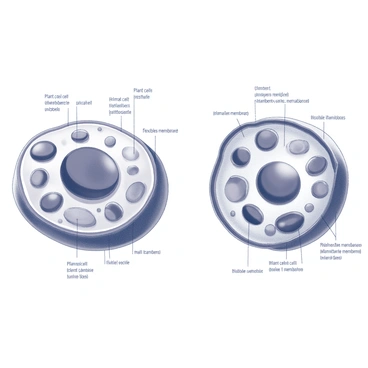
A close-up view of a chloroplast's internal structure, featuring stacks of thylakoids, which resemble small, disc-like compartments. The thylakoids are surrounded by a fluid-filled stroma that contains various proteins and enzymes essential for photosynthesis. There are visible granum structures formed by the thylakoid stacks. The overall composition emphasizes the intricate details and organization of the chloroplast, highlighting its role as a crucial component in the process of converting light energy into chemical energy.A close-up view of a cell's cytoskeleton, showcasing a dense network of microtubules interwoven with actin filaments. The microtubules are cylindrical structures, appearing as long, thin tubes that provide structural support, while the actin filaments are thinner and more flexible, resembling strands of a web. The microtubules are depicted in bright colors with a smooth gradient, and the actin filaments are shown in contrasting shades, adding depth to the image. The background features a subtle representation of the cell membrane, providing context for the cytoskeletal elements.A lysosome with a semi-transparent membrane, showing its interior filled with enzymes, is actively breaking down various forms of cellular waste material. Fragments of proteins, lipids, and organelles are visible inside the lysosome, illustrating the degradation process. The surrounding cell membrane encapsulates the lysosome, with other cellular components like mitochondria and the endoplasmic reticulum nearby, showcasing the cellular environment. There is a clear depiction of the complex interactions occurring within the cell.Ribosomes depicted as small spherical structures attached to the surface of the endoplasmic reticulum. The endoplasmic reticulum is shown as a series of interconnected membranes with a textured surface. A few protein chains are illustrated emerging from the ribosomes, representing the process of protein synthesis. The overall composition highlights the intricate relationship between the ribosomes and the endoplasmic reticulum.A close-up view of a "chromosome" showcasing "visible DNA coiling" in intricate detail. The structure displays the alternating segments of "chromatin" and "nucleosomes" along its length. The "DNA strands" are tightly wound, exhibiting a distinct helical pattern. Surrounding the chromosome, a faint outline of "histones" can be seen, emphasizing the organization of the genetic material. The background remains simple, ensuring the focus remains on the complexity of the chromosome and its coiled DNA.A detailed illustration of a bacterium, featuring a distinct oval shape with smooth, glossy surfaces. Its outer membrane appears semi-transparent, showcasing a vibrant color palette of greens and blues. Inside the bacterium, various internal structures are clearly labeled, such as the nucleus, ribosomes, and cell wall. Each structure is depicted in a different color for clarity, with arrows pointing from the labels to the respective components. The background is a subtle gradient to emphasize the bacterium’s features and labeled parts.A cross-section of a cell membrane showcasing the "lipid bilayer" with "phospholipid molecules" arranged in two layers. The "hydrophilic heads" are facing outward while the "hydrophobic tails" are oriented inward. Embedded within the bilayer are various "proteins," including "integral proteins" that span the membrane and "peripheral proteins" attached to the surface. There are also "carbohydrate molecules" linked to some of the proteins, highlighting their role in cell recognition. The overall structure is depicted in a clear and detailed manner, emphasizing the organization of these components.An illustration depicting a cluster of stem cells at the center. Surrounding the stem cells are various types of differentiated cells, each representing a unique cell type. There are muscle cells with elongated shapes, nerve cells with branching axons, and blood cells in circular forms. The stem cells exhibit a slightly distinct texture compared to the differentiated cells, highlighting their unique and versatile nature. The background is minimal, focusing attention on the cellular transformations and the diversity of cell types emerging from the stem cells.A virus with a spherical shape and distinct spikes is shown approaching a host cell. The host cell is depicted as a rounded structure with a textured surface. The virus is making contact with the outer membrane of the host cell, showing the initial stages of attachment. The area around the virus and host cell is highlighted to emphasize the interaction. The background is blank to keep the focus on the virus and the host cell.A detailed illustration depicting a side-by-side comparison of a eukaryotic cell and a prokaryotic cell. The eukaryotic cell is larger with a well-defined nucleus, surrounded by a nuclear membrane, and contains various organelles like mitochondria and endoplasmic reticulum, colored in vibrant hues for clarity. The prokaryotic cell is smaller, lacking a nucleus, with its genetic material freely floating in the cytoplasm, and a cell wall that appears distinctively outlined. Key differences between the two cells are highlighted with labels: eukaryotic cell features include "nucleus," "membrane-bound organelles," and "larger size," while prokaryotic cell features include "no nucleus," "smaller size," and "simple structure." The background is a clean white to emphasize the cells and their unique characteristics.An illustration of a plant cell showcasing multiple "chloroplasts" engaged in the process of "photosynthesis." The cell membrane is visible, enclosing the contents of the cell. The chloroplasts are depicted as oval-shaped structures with a vibrant green color, exhibiting granum stacks inside them. Surrounding the chloroplasts are various cell organelles, including a large "vacuole" and "mitochondria." Distinct layers of the cell wall surround the plant cell, providing structure. The background features a gradient of "pastel colors," enhancing the overall visual appeal of the illustration.An illustration depicting the process of gene expression, featuring a DNA double helix unwinding at the top. Below, strands of mRNA are shown being synthesized from the DNA template. In the middle section, ribosomes are illustrated with mRNA strands being fed through them. On one side, tRNA molecules are depicted carrying specific amino acids towards the ribosome. The final section shows a chain of amino acids forming into a protein structure with distinct shapes. Each step is clearly labeled with arrows indicating the flow from DNA to mRNA to protein.An illustration depicting a cell membrane with aquaporin channels embedded in it. The membrane is shown as a double layer with a green and purple outline. Numerous water molecules, represented as small circles, are passing through the aquaporin channels. The aquaporin channels are illustrated as elongated structures within the membrane, allowing the water molecules to flow through. The interior of the cell is visible, showing the presence of other cellular structures in the background. The overall composition emphasizes the movement of water molecules and the function of the aquaporin channels.An illustration depicting a detailed cellular environment with multiple cells in close proximity. Each cell is a different color, showcasing their distinct types, such as red blood cells, neurons, and epithelial cells. Chemical signals, represented by glowing particles in various colors, are shown being released from one cell and traveling towards adjacent cells. The particles are illustrated with lines or trails to indicate movement. Additionally, receptor sites on the surfaces of the receiving cells are visible, highlighting the interaction between the signals and the cells. The background includes subtle details of a tissue structure to enhance the context of cellular communication.A detailed illustration of a cell interior, prominently featuring both the smooth and rough endoplasmic reticulum. The rough endoplasmic reticulum is depicted with ribosomes attached to its surface, illustrating its role in protein synthesis. It has a folded, labyrinthine structure. The smooth endoplasmic reticulum appears adjacent, characterized by a tubular and more streamlined appearance, emphasizing its function in lipid synthesis and detoxification. The surrounding cytoplasm is filled with other cellular components, such as mitochondria and a nucleus, providing context to the functions of the endoplasmic reticulum.A close-up view of a DNA double helix with a twisting structure. The strands are composed of a colorful sequence of nucleotides, each represented with distinct colors. The nucleotides are clearly labeled with their respective names: "adenine," "thymine," "cytosine," and "guanine." The background is a soft gradient that enhances the visibility of the double helix and labeled nucleotides.A macrophage is depicted with a large, round cell body, extending pseudopodia to surround and engulf a cluster of bacteria. The bacteria are small, rod-shaped, and appear to be in the process of being internalized by the macrophage. The scene is filled with soft gradient pastel colors, emphasizing the dynamic interaction. Surrounding the macrophage, there are smaller immune cells in various stages of response, creating a sense of action and biological activity. Fine details within the macrophage highlight its cellular structure, while the background softly blends in shades of light colors, enhancing the focus on the macrophage and bacteria.An illustration of a mitochondrion within a cell, showcasing its oval shape with a double membrane. The inner membrane is folded into cristae. Bright yellow and orange light rays are depicted emanating from the mitochondrion, symbolizing the generation of energy. Surrounding the mitochondrion is a semi-transparent cell membrane with a smooth texture, allowing glimpses of the cytoplasm filled with small organelles.A modern pastel illustration showcasing different types of tissues. On one side, there is a detailed depiction of "muscle tissue" with elongated, striated cells arranged tightly together. The other side features "epithelial tissue" represented by layers of closely packed cells, with some regions showing varied shapes such as squamous, cuboidal, and columnar. In the background, a subtle grid pattern complements the scientific theme, emphasizing the cellular structures. Each tissue type is labeled clearly with its name in elegant, contrasting font.A detailed diagram featuring a side-by-side comparison of a plant cell and an animal cell. The plant cell is depicted with a rigid cell wall, chloroplasts, and a large central vacuole, showcasing its distinct organelles. The animal cell is shown without a cell wall, featuring a flexible membrane and various organelles such as lysosomes and centrioles. Each organelle is clearly labeled, providing a clear visual representation of the differences between the two cell types. The layout is organized for easy comparison, with both cells drawn to scale to highlight their structural differences.An illustration depicts a cell with a semi-permeable membrane. On the left side, the process of "endocytosis" is shown, where a section of the membrane is folding inward to form a vesicle. The vesicle contains food particles that are being engulfed by the cell. The background features small, colorful organelles such as mitochondria and ribosomes. On the right side, the process of "exocytosis" is illustrated, where a vesicle is merging with the membrane to release waste products outside the cell. Tiny particles can be seen exiting the vesicle into the surrounding space. The cell itself has a light blue color, with a slightly darker blue outline.A Golgi apparatus depicted as a series of stacked, flattened membrane-bound sacs. The structure is colored in shades of light pink and light yellow. Small vesicles are shown budding off from the edges of the Golgi, representing the packaging stage of proteins. Each vesicle is clear and slightly reflective, suggesting they contain modified proteins. Surrounding the Golgi apparatus are stylized representations of ribosomes and rough endoplasmic reticulum, illustrating the cellular environment. The background is a simple gradient, enhancing the focus on the Golgi structure.A collection of specialized cells displayed together on a clean, illuminated surface. In the center, a detailed nerve cell with long, branching axons and a cell body, showcasing intricate connections. To the left, a muscle cell with striations, elongated shape, and numerous nuclei visible along its length. To the right, a blood cell, spherical and smooth, with a biconcave shape. Each cell type is labeled with its name in bold, clear text, and the background remains simple to highlight the cells. The arrangement emphasizes the differences in structure and function among the various cell types.An illustration of a cell undergoing mitosis on one side and meiosis on the other side. The mitosis section shows a parent cell dividing into two identical daughter cells, with distinct chromosomal structures clearly visible. The meiosis section displays a parent cell dividing into four genetically diverse daughter cells, highlighting the two stages of division with corresponding chromosomal arrangements in each phase. The background should have a neutral color to accentuate the cellular details. Each division process is labeled with "Mitosis" on one side and "Meiosis" on the other.A detailed illustration of a cell undergoing mitosis is presented, with each stage clearly visible. The first stage, prophase, shows the chromatin condensing into distinct chromosomes, with spindle fibers beginning to form. The next stage, metaphase, features the chromosomes aligned along the cell's equatorial plane, attached to the spindle at their centromeres. During anaphase, the sister chromatids are pulled apart toward opposite poles of the cell. Finally, in telophase, the chromosomes de-condense back into chromatin, and the nuclear membranes reform around each set of chromosomes. The entire process is depicted in a sequential layout to enhance clarity, with arrows indicating the progression from one stage to the next.
В сообществе ничего не найдено