Brachial plexus

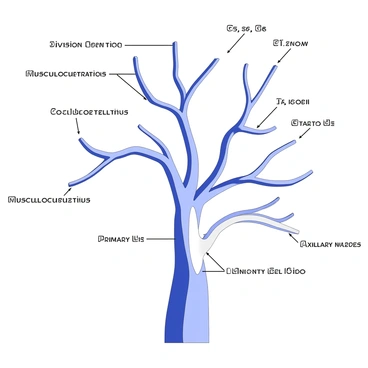
A black-and-white illustration of the brachial plexus, featuring clean, simple lines defining the network of nerves. The nerves are arranged in a way that clearly shows their interconnections, with branches extending from a central point. The overall composition is uncluttered, emphasizing the structure and layout of the brachial plexus.A futuristic interface displaying a detailed scan of the "brachial plexus." The scan features vibrant colors, highlighting the intricate network of nerves. The background is filled with digital elements, such as grid lines and circuit patterns, enhancing the sci-fi theme. The nerves are shown in various shades of blue and green, with labels identifying key components. There are glowing effects around the scanned area, creating a sense of advanced technology.A detailed illustration of the brachial plexus, showcasing the intricate network of nerves. The nerves are depicted with clear, defined lines and dynamic shading to emphasize their structure and interconnections. Labels for each part of the plexus are included, displayed in bold lettering around the illustration. The background is minimal to draw focus on the brachial plexus itself.A detailed illustration of the brachial plexus represented with interconnected lines and nodes. The nodes are depicted as colorful spheres in various shades of blue, green, and yellow. The lines connecting the nodes are shown as smooth, flowing curves that weave around each other. The background is a soft gradient that enhances the visibility of the brachial plexus structure.An X-ray style illustration of the human torso with the brachial plexus prominently visible. The brachial plexus appears as a network of intricate nerves branching out from the spinal cord, depicted in a glowing effect. The surrounding skeletal structure is detailed, showing the collarbone, ribs, and upper spine, all rendered in black and white. The image captures the complexity and connectivity of the nervous system, with the brachial plexus at the center of the composition.An origami design representing the brachial plexus structure is displayed prominently. The intricate folds of paper form multiple branches that resemble the nerve pathways, creating a detailed representation of the anatomical configuration. Each section of the origami is meticulously crafted to highlight the connections and separations between different nerve roots and trunks. The model is positioned on a flat surface, allowing for a clear view of the unique shapes and angles formed by the folded paper. The design showcases the complexity of the brachial plexus in a visually engaging way, inviting exploration from various perspectives.A bubble diagram with distinct sections labeled "Roots," "Trunks," "Divisions," "Cords," and "Branches" of the brachial plexus. Each section is represented by circular bubbles connected by lines, illustrating the relationships between them. The "Roots" bubble is positioned at the top and is connected to the "Trunks" bubble, which leads into three "Divisions" bubbles. The "Cords" bubble is below the "Divisions," leading to multiple "Branches" bubbles at the bottom. Each bubble is outlined clearly, with labels in bold text inside them for clarity.A modern pastel illustration depicting a medical infographic focused on the "brachial plexus anatomy." The central element is a detailed, labeled diagram of the brachial plexus, showcasing the network of nerves. Surrounding the diagram are various related icons, including a human silhouette with highlighted areas corresponding to the brachial plexus, a stethoscope, and a medical chart. Each icon is in soft pastel colors like light blue, green, and peach. The background is a subtle gradient, enhancing readability and emphasizing the anatomical details.A 3D diagram of the brachial plexus with bold colors. The diagram includes distinct nerve pathways clearly labeled. Each nerve is represented in a different bright color for easy identification. The overall structure shows the interconnectedness of the nerves radiating from the spinal cord. The background is kept simple to emphasize the colorful representation of the brachial plexus.A transparent overlay illustration displaying the "brachial plexus" over various "anatomical structures". The brachial plexus is represented in intricate detail, illustrating the network of nerves branching from the spinal cord. The underlying anatomical structures include the "shoulder", "arm", and "neck" regions, with clear labels and color distinctions for each component. The illustration is designed to convey a clear understanding of the brachial plexus's position and relationship to surrounding muscles and bones.A detailed depiction of the brachial plexus with clearly defined nerves. The nervous system structure is shown in an intricate arrangement, illustrating the major branches such as the median, ulnar, and radial nerves. Each nerve is represented in a different vibrant color for easy differentiation. The background is neutral to highlight the vivid colors of the nerves and their connections. The overall presentation is precise, allowing for a clear understanding of the anatomy of the brachial plexus.A detailed illustration of the brachial plexus depicted in black and white, showcasing the intricate network of nerves branching from the spinal cord. The nerves are clearly defined and labeled, with emphasis on their connections and pathways. Surrounding the plexus are annotations identifying each nerve involved, providing clarity to the anatomical structure.A 3D rendering of the "brachial plexus" with detailed nerve pathways and connections. The nerves are depicted in vibrant colors, showcasing their anatomy and branching structure. Each nerve is labeled with clear text for identification. The background is a neutral color to highlight the complex network of the brachial plexus. The view is angled to emphasize the depth and intricate organization of the nerves.An interactive hologram is displayed in a dimly lit room, showcasing the "brachial plexus" in three-dimensional form. The hologram consists of intricate, translucent structures representing nerves, interconnected and branching outwards. The background is simple, allowing the focus to be on the vibrant holographic representation. A person stands in front of the hologram, using their hands to manipulate and rotate the 3D model, examining the various components closely. The person's attention is captured by the detailed display of the nerve pathways. The hologram emits a soft glow, highlighting the complexity of the "brachial plexus" while remaining visually engaging.A simplified schematic drawing of the brachial plexus is displayed. The illustration consists of a central network of nerves branching out from the spinal cord, labeled to indicate various components. Primary trunks are shown, leading to divisions and cords, with clear, straight lines connecting each segment. Annotations provide information on the C5, C6, C7, C8, and T1 nerve roots, and labels for the musculocutaneous, median, ulnar, radial, and axillary nerves are prominently placed. The overall design is clean and organized for educational clarity.A page from a vintage medical textbook featuring an illustration of the brachial plexus. The diagram displays the network of nerves in a detailed and labeled manner. The nerves are color-coded for clarity, with distinct colors representing different branches. Anatomical labels are written in an elegant, old-fashioned font. The background of the page has a slightly worn texture, giving it an authentic vintage feel. The overall composition emphasizes the complexity and importance of the brachial plexus in the human body.A medical training illustration displaying a tactile model of the "brachial plexus." The model is composed of colorful, segmented nerves arranged in an anatomical fashion, showcasing their pathways. Each nerve is labeled clearly with small text to indicate their names. The background features a smooth surface, enhancing the focus on the model. Surrounding the model, there are small tools such as a pair of tweezers and a magnifying glass, indicating a hands-on training environment.A detailed anatomical diagram of the brachial plexus nerves in the human shoulder. The diagram includes the major nerves: the musculocutaneous nerve, the median nerve, the ulnar nerve, the radial nerve, and the axillary nerve. Each nerve is labeled clearly in a contrasting color against the background. The nerves emerge from the spinal roots located in the neck region and travel through the axillary area. The diagram also features the surrounding muscles and bones, such as the scapula and the humerus, providing context to the anatomical location of the brachial plexus. The visual presentation emphasizes the intricate network of nerves, ensuring clarity and precision in the detail.A detailed illustration of a 3D printed model of the brachial plexus displayed on a pedestal. The model showcases intricate, interconnected nerves forming a complex network. Each nerve branch is prominently visible, with labeled sections that highlight the different parts of the plexus such as the roots, trunks, divisions, cords, and branches. The model is positioned against a neutral backdrop to emphasize its structural details, with a slight shadow cast onto the pedestal to add depth. A ruler is placed alongside the model for scale, indicating the size of the anatomical representation.A detailed cross-sectional view of a human shoulder. The shoulder joint is prominently displayed, showcasing the humerus, scapula, and clavicle. The brachial plexus is highlighted in a vibrant color, with distinct nerve branches clearly visible extending from the spinal cord to the upper limb. Surrounding structures, including muscles such as the deltoid and rotator cuff, are depicted in soft pastel tones for clarity. Annotations label the major components, ensuring a clear understanding of the anatomy.A detailed black-and-white illustration of the brachial plexus network displayed with intricate lines and connections, showing the complex interweaving of nerves. The brachial plexus is surrounded by stylized depictions of muscles, emphasizing their anatomy and structure. Each muscle is outlined clearly, demonstrating how they interact with the nerve network. The overall composition is organized to highlight the relationship between the brachial plexus and muscular elements, creating a cohesive visual representation of the anatomy.A detailed medical chart is displayed on a wall. The chart features an illustration of the brachial plexus, prominently labeled with the names of various parts and areas. The illustration clearly shows the network of nerves, with each branch distinctly outlined in green and purple. There are labels beside each section including "C5," "C6," "C7," "C8," and "T1" indicating the spinal roots. Additional annotations highlight the trunks, divisions, and cords of the brachial plexus, providing clarity to the illustration. The background is plain, focusing attention on the informative content of the chart.A hand-drawn style sketch of the brachial plexus is displayed on a white background. The illustration depicts the network of nerves originating from the spinal cord, branching out into different areas. Each nerve is labeled with clear annotations, showing terms such as "median nerve," "ulnar nerve," and "radial nerve." The sketch includes the surrounding muscles and the pathways of the nerves, providing context for their locations. Each section of the brachial plexus is distinctly marked to enhance understanding. The overall layout is organized and easy to follow, creating a comprehensive visual guide.A modern pastel illustration depicting an interactive 3D model of the "brachial plexus." The model is detailed with colorful nerves, showcasing various shades of blue, green, and yellow. Surrounding the model are labeled diagrams indicating different nerve roots, including "C5," "C6," "C7," "C8," and "T1." There is also a touchscreen display showing additional information about the anatomy and functions of the brachial plexus. The background includes various medical books and anatomical charts, enhancing the educational theme of the scene.A detailed illustration showing a 3D representation of the brachial plexus. The image includes different views of the brachial plexus, highlighting its complex network of nerves. Each view should be distinct, with clear labeling of major components such as trunks, divisions, cords, and terminal branches. The colors should be used to differentiate between the various parts, with vibrant hues for visibility. The background remains neutral to accentuate the brachial plexus structure.An illustration depicting the brachial plexus in the style of historical medical art. The brachial plexus is shown as a detailed network of nerves branching from the spinal cord and extending into the shoulder and arm. Each nerve is labeled with its anatomical name. The illustration includes surrounding anatomical structures such as the cervical vertebrae and surrounding muscles, providing context to the brachial plexus. The lines are intricate and meticulous, capturing the complexity of the nerve network.
В сообществе ничего не найдено